
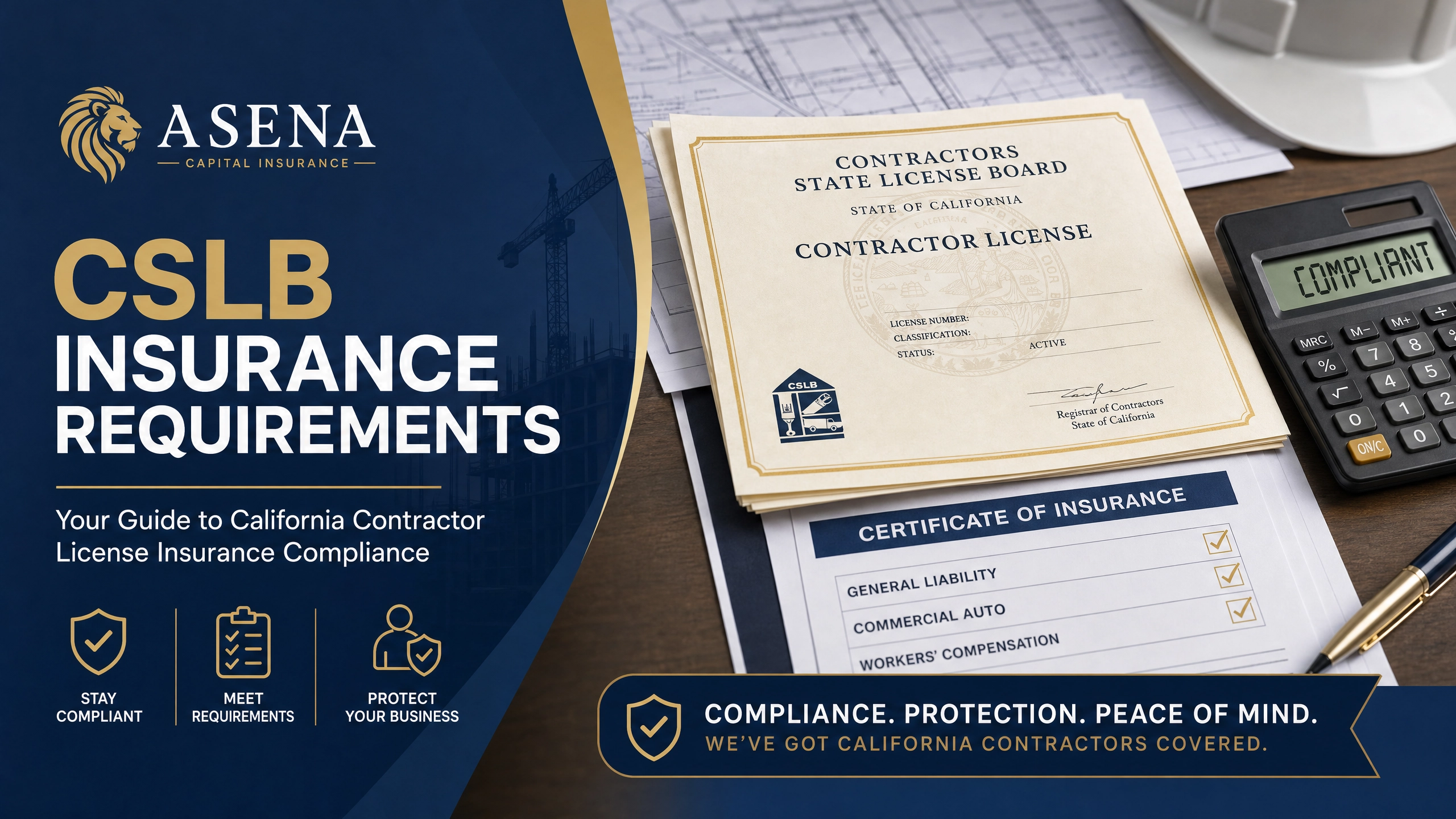
Every active California contractor's license requires: (1) a $25,000 contractor's license bond, (2) workers' compensation insurance (or exemption form if no employees), and (3) general liability insurance is strongly recommended but not always required by CSLB — however, LLCs must carry GL starting at $1M. Failure to maintain these can result in automatic license suspension.
The Three Core CSLB Insurance Requirements
The California Contractors State License Board (CSLB) enforces three primary insurance and bonding requirements for all active contractor licenses. Understanding each requirement — and the nuances for different business structures — is essential for maintaining your license in good standing.
1. Contractor's License Bond ($25,000)
Every California contractor must maintain a $25,000 contractor's license bond (also called a surety bond) as a condition of licensure. This bond protects consumers if a contractor fails to complete work, violates the Contractors License Law, or causes damage.
Key facts about the contractor's license bond:
- Amount: $25,000 (increased from $15,000 in 2023)
- Type: Continuous (renews automatically, billed annually)
- Cost: Typically 1–3% of face value (pricing varies by classification, payroll, operations, claims history, limits, and underwriting/year depending on credit)
- Filing: Your surety company e-files directly with CSLB — you don't file it yourself
- Separate from insurance: A bond is not insurance. It protects the public, not the contractor.
2. Workers' Compensation Insurance
California Labor Code §3700 requires all employers to carry workers' compensation insurance. For contractors, this means:
- If you have employees: You must carry standard WC insurance covering all employees
- If you have no employees: You must file a Certificate of Exemption with CSLB — OR carry a ghost policy (required for Phase 1 trades)
- Phase 1 trades (C-8, C-20, C-22, C-39, C-61/D-49): Must carry WC even with no employees (since 2023)
- All other trades: Must carry WC even with no employees by January 1, 2028 (SB 1455)
3. General Liability Insurance
General liability insurance is not universally required by CSLB for all contractor types — but it is required for LLCs and is strongly recommended for all contractors. Here's the breakdown:
| Business Structure | GL Requirement | Minimum Limit |
|---|---|---|
| LLC (5 or fewer personnel) | Required by CSLB | $1,000,000 aggregate |
| LLC (6–10 personnel) | Required by CSLB | $1,000,000 + $100K per additional person |
| LLC (max) | Required by CSLB | $5,000,000 aggregate maximum |
| Sole Proprietor | Strongly Recommended | $1M/$2M industry standard |
| Corporation | Strongly Recommended | $1M/$2M industry standard |
| Partnership | Strongly Recommended | $1M/$2M industry standard |
Important disclosure rule: If you don't carry GL insurance, you must disclose this in 14-point bold type on every home improvement contract. Failure to disclose is a violation of the Contractors License Law.
LLC-Specific Requirements
LLCs operating as contractors in California have additional requirements beyond the standard bond and WC:
- $100,000 LLC Employee/Worker Bond: Required for all LLC contractor licenses. This bond covers wages and benefits owed to employees. It is separate from and in addition to the $25,000 contractor's license bond.
- General Liability Insurance: Minimum $1 million aggregate (for 5 or fewer personnel of record), increasing by $100,000 per additional person, up to a maximum of $5 million.
Both the LLC bond and GL policy must be filed with CSLB. Your carrier e-files the GL certificate; your surety e-files the LLC bond.
How to Verify Your CSLB Insurance Status
You can check whether your insurance and bond filings are current with CSLB at any time:
- Go to cslb.ca.gov
- Click "Check a License" or "Verify a License"
- Enter your license number
- Review the "Insurance" and "Bond" sections of your license record
If your bond or WC certificate has lapsed, your license will show as "Suspended" and you cannot legally perform contracting work until the filing is updated.
License Renewal and Insurance
California contractor licenses renew every two years. At renewal, CSLB verifies that your bond and WC certificate are current. Key renewal requirements:
- Workers' comp certificate must be current (your carrier re-files annually)
- WC exemption must be re-signed at every license renewal (2-year cycle)
- Bond is continuous but surety bills annually — watch for payment lapses
- LLC GL policy must be current and on file