California Contractor Insurance – Coverage Options for Licensed Trades
Workers' Comp • General Liability • Commercial Auto
Asena Capital Insurance Services is a California-licensed independent insurance agency serving contractors statewide. We review Workers' Compensation, Commercial Auto, General Liability, bond, BOP, and specialty coverage options around your trade, payroll, vehicles, contracts, and operations. Recommendations and pricing depend on carrier eligibility and underwriting.
Start with your trade, employees, vehicles, or contract needs.
2
Share business details
Tell us about operations, entity type, limits, and current coverage.
3
Licensed review
We explain available options subject to carrier eligibility and underwriting.
TRADE REQUIREMENTS
Insurance Requirements for Popular California Contractor Trades
A contractor’s requirements depend on employees, entity type, license classification, vehicles, contracts, and current California rules. Use this as a starting point, then request a review for your specific operations.
Search by trade to narrow the requirements guidance.
CSLB describes C-60 Welding work as permanently attaching, joining, and fabricating metals using gases and electrical energy at sufficient heat. Welding businesses commonly review Workers’ Compensation when applicable, General Liability, Commercial Auto, tools or equipment, completed operations, contracts, and the applicable CSLB bond.
CSLB describes C-54 Ceramic and Mosaic Tile work as preparing surfaces and installing ceramic, mosaic, quarry, paver, faience, glass mosaic, and stone tiles and related tile units, subject to the classification’s listed exclusions. Tile businesses commonly review Workers’ Compensation when applicable, General Liability, Commercial Auto, tools or equipment, completed operations, contracts, and the applicable CSLB bond.
CSLB describes C-29 Masonry work as installing concrete units, baked clay products, block, natural or manufactured stone, terra cotta, refractory materials, masonry walls and fences, paving, and incidental waterproofing, cleaning, and caulking. Masonry businesses commonly review Workers’ Compensation when applicable, General Liability, Commercial Auto, equipment, completed operations, contracts, and the applicable CSLB bond.
CSLB describes C-9 Drywall work as laying out and installing gypsum wallboard and assemblies, including nonstructural metal framing, taping, texturing, and related compounds. Drywall businesses commonly review Workers’ Compensation when applicable, General Liability, Commercial Auto, tools or equipment, completed operations, contracts, and the applicable CSLB bond.
CSLB describes a Class A General Engineering Contractor as principally working on fixed works that require specialized engineering knowledge and skill, including infrastructure, utilities, roads, bridges, pipelines, grading, trenching, paving, and related works. These operations should be reviewed for Workers’ Compensation when applicable, General Liability, Commercial Auto, equipment, contract, and project requirements.
CSLB describes a Class B General Building Contractor as principally working on structures requiring at least two unrelated building trades or crafts, subject to statutory limitations and specialty-classification rules. General Building operations should be reviewed for Workers’ Compensation when applicable, General Liability, Commercial Auto, equipment, contract, and project requirements.
The C-36 Plumbing Contractor classification covers systems for supplying safe water, disposing of fluid waste, gas piping and appliances, and related equipment. Plumbers commonly review the applicable contractor license bond, Workers’ Compensation when they have employees, General Liability for project or customer requirements, and Commercial Auto when vehicles are used for business.
The C-10 Electrical Contractor classification covers placing, installing, erecting, or connecting electrical wires, fixtures, apparatus, raceways, conduits, and related systems. Electricians commonly review the applicable contractor license bond, Workers’ Compensation when they have employees, General Liability for contracts and project access, and Commercial Auto for work vehicles and tools.
The C-39 Roofing Contractor classification covers installing and repairing materials that seal, waterproof, and weatherproof structures. CSLB identifies active C-39 licensees as required to carry Workers’ Compensation insurance or valid self-insurance even without employees. Roofers should also review the applicable bond, General Liability for project requirements, Commercial Auto, and tools or equipment exposure.
The C-20 Warm-Air Heating, Ventilating and Air-Conditioning classification covers installing, maintaining, servicing, and repairing qualifying heating, ventilation, air-conditioning, duct, and control systems. CSLB identifies active C-20 licensees as required to carry Workers’ Compensation insurance or valid self-insurance even without employees. HVAC businesses should also review the applicable bond, General Liability, Commercial Auto, and equipment needs.
The C-8 Concrete Contractor classification covers forming, pouring, placing, finishing, and installing specified concrete work. CSLB identifies active C-8 licensees as required to carry Workers’ Compensation insurance or valid self-insurance even without employees. Concrete businesses should also review the applicable bond, General Liability for project requirements, Commercial Auto, and equipment exposure.
CSLB’s C-49 Tree and Palm classification includes planting, maintaining, and removing trees and palms, including pruning and stump grinding. Active C-61/D-49 Tree Service licensees are identified by CSLB as required to carry Workers’ Compensation insurance or valid self-insurance even without employees. Tree-service businesses should also review the applicable bond, General Liability, Commercial Auto, and equipment needs.
The C-27 Landscaping Contractor classification covers constructing, maintaining, repairing, installing, or subcontracting landscape systems and preparing or grading land for landscape treatments. Landscaping businesses should review the applicable contractor bond, Workers’ Compensation when they have employees, General Liability for contracts and property exposures, Commercial Auto, and equipment coverage based on operations.
The C-33 Painting and Decorating Contractor classification includes preparing surfaces and applying paints, papers, textures, fabrics, coatings, adhesives, and related materials for decorating, protecting, fireproofing, and waterproofing. Painting businesses should review the applicable bond, Workers’ Compensation when they have employees, General Liability for completed work and project requirements, Commercial Auto, and equipment coverage.
Compare common compliance context with items to review for your actual operation.
Coverage
Standard / compliance context
Recommended review
Why it matters
Workers’ Compensation
Employee-based statutory requirement; special CSLB classifications may differ
Review payroll, classifications, subcontractors, and California filing needs
Protects employees and supports license or contract documentation when applicable.
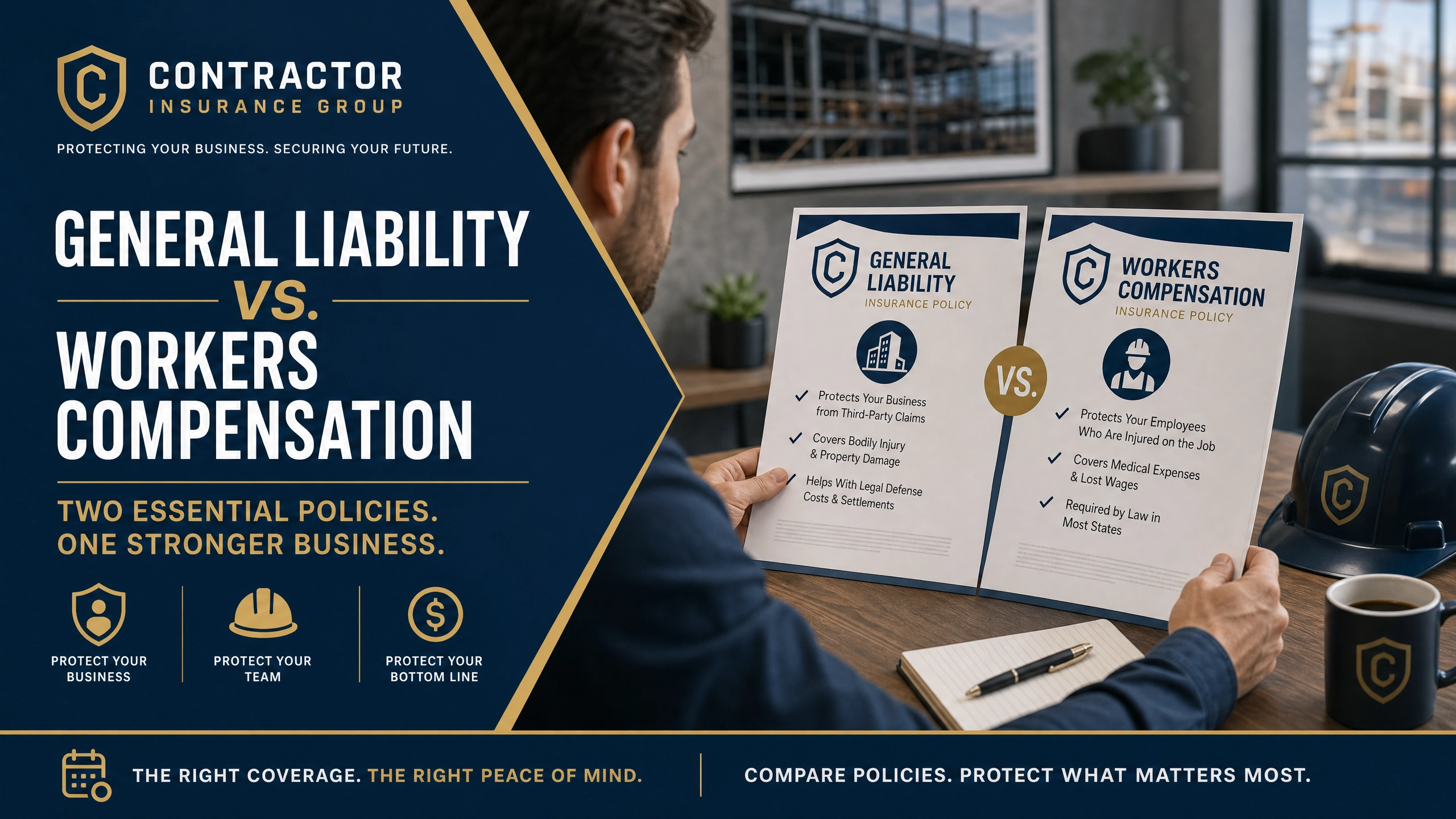
General Liability
No single CSLB-wide liability limit
Use the contract-required limit and review completed-operations exposure
Project owners and GCs may require specific limits, additional insured status, or completed-operations terms.
Commercial Auto
No universal CSLB limit
Match limits to vehicles, drivers, contracts, and transported tools/materials
Business-use vehicle losses can exceed personal-auto coverage and may affect contract eligibility.
Contractor License Bond
Applicable CSLB bond; amount depends on current rules and business structure
Confirm the current bond amount and any additional bond obligations with CSLB
The bond supports licensing compliance; it is not a substitute for liability insurance.
This comparison is an educational starting point, not a quote, legal opinion, or universal limit schedule. CSLB mandates vary by classification and circumstances; liability, auto, and other limits may be contract-driven and remain subject to carrier eligibility and underwriting. Confirm current requirements with CSLB, California DWC, and a licensed insurance professional.
Workers’ Compensation requirements are governed by California law and depend on who qualifies as an employee. The California Division of Workers’ Compensation states that employers with one or more employees must provide Workers’ Compensation benefits. Requirements, eligibility, terms, limits, and pricing should be confirmed with a licensed professional and the applicable state agencies.
Answers stay available in the page markup for search engines and expand or collapse for visitors. Confirm current requirements with CSLB, DWC, and your licensed insurance professional.
CSLB states that active contractor licensees must maintain the applicable contractor license bond. Bond amount and any additional bond obligations depend on the license and business structure, so confirm the current requirement with CSLB.
CSLB identifies active C-39 Roofing and C-20 Warm-Air Heating, Ventilating and Air-Conditioning classifications among the classifications required to carry Workers' Compensation insurance or a valid Certification of Self-Insurance, whether or not they have employees.
An exemption may be available when a contractor has no employees and meets CSLB’s requirements. CSLB states that exemptions are not available for certain classifications, including C-20 HVAC and C-39 Roofing, and an exemption becomes invalid when covered employees are hired.
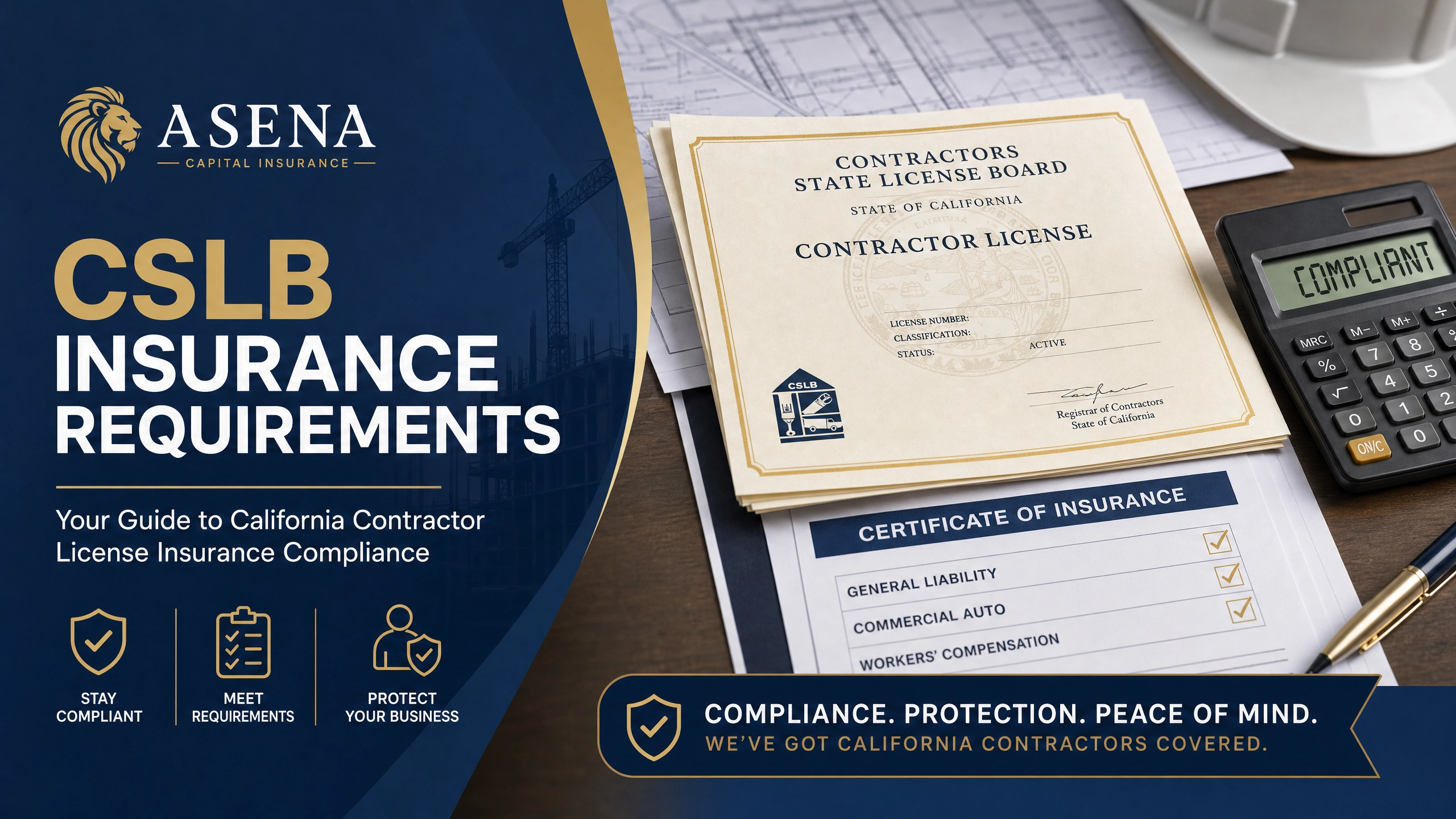
CSLB’s guidance lists the contractor or application number, CSLB as certificate holder, policy number, effective and expiration dates, and an authorized insurer representative’s signature among the required certificate details.
There is no single coverage answer for every contractor. General Liability may be required by a project contract, customer, lender, or business structure, while other requirements depend on the license, employees, vehicles, operations, and current rules. Request a review based on the actual business.
Insurance and bond considerations vary by CSLB class, employees, vehicles, entity type, operations, and project contracts. Review guidance for your trade.
Enter a license code such as C-10, C-39, or Class B to review common insurance and bond considerations for that trade. Final requirements and eligibility depend on your business and current law.
Coverage Guidance for California Contractor Businesses
We review your trade, employees, vehicles, operations, entity type, contracts, limits, and loss history before comparing eligible insurance and bond options.
California Contractor Requirement Review
We help identify insurance and bond considerations connected to your CSLB class, business entity, employees, vehicles, and project contracts. Final obligations depend on current law and your individual circumstances.
Our Simple Process
1
Share Business Details
Tell us your trade, operations, and coverage needs
2
We Review Options
We compare available carrier and surety options
3
Choose Informed Coverage
Review terms, limits, pricing, and underwriting conditions
California licensees must maintain the applicable contractor bond. Workers' Compensation obligations depend on employees, trade classification, and current law. General Liability is commonly required by project contracts and is mandatory for CSLB LLC licensees under B&P Code §7071.19. We review each business individually.
Workers' Compensation requirements for sole proprietors depend on trade classification, employees, and current SB 216 and SB 1455 rules. We review eligibility and carrier options before making a recommendation.
California's CSLB requires active contractor licensees to maintain the applicable $25,000 contractor license bond. This is a surety bond rather than an insurance policy, and premium and issuance remain subject to surety underwriting.
Coverage needs vary by employees, vehicles, entity type, operations, and project contracts. These trades commonly consider General Liability, Workers' Compensation, Commercial Auto, tools or equipment coverage, and the applicable CSLB bond.
Timing depends on application completeness, carrier underwriting, required documents, payment, and the requested effective date. Our team coordinates the application and certificate process after coverage is approved and bound.
Ready to get covered?
coverage options based on your trade and operations · No obligation
Coverage needs vary by employees, vehicles, entity type, trade, and contract. Common considerations include General Liability, Workers' Compensation, the applicable Contractor License Bond, Commercial Auto, and tools or equipment coverage.
Choose a coverage path or request a California contractor insurance quote review. A licensed team member can review your trade, operations, payroll, vehicles, contracts, and current coverage, subject to carrier eligibility and underwriting.
Certificate timing depends on the policy being approved and bound, payment, and the certificate holder's requirements. We coordinate certificate requests after coverage is active.
We help contractors across Class A, Class B, and specialty trades evaluate insurance and bond options. Carrier eligibility and available coverage depend on the business, operations, license class, and underwriting.
Premium depends on trade, revenue, payroll, vehicles, limits, location of operations, claims history, and carrier underwriting. Submit current business details for a quote subject to underwriting.
Our team focuses on California contractor risks, including Workers' Compensation, Commercial Auto, General Liability, bonds, and certificate support. We compare available carrier options and explain how coverage may apply to your trade and operations.
Why California Contractors Work With Asena
California-focused guidance for contractor insurance, bonds, vehicle risks, certificates, and coverage coordination.
As a licensed California insurance broker, our team helps organize business details for a coverage review and explains how available options may apply to your trade and operations. Recommendations remain subject to carrier eligibility and underwriting.
Coverage Coordination
We organize application details, underwriting questions, coverage comparisons, and certificate requests after coverage is active.
California Contractor Focus
We evaluate how CSLB class, entity type, employees, vehicles, and project contracts affect common coverage considerations.
Licensed Team Support
Speak with a licensed team member about application information, available options, and policy servicing questions.
Carrier Option Review
We compare available options based on carrier appetite, trade, operations, limits, loss history, and underwriting.
Preliminary Price Indication
Select coverage types or describe what you need. Any preliminary indication is subject to complete application details and carrier underwriting.
Requirement Guidance
We explain common bond and insurance considerations; final legal and contract obligations depend on your circumstances.
Asena Capital Insurance Services serves California contractor businesses across Class A, Class B, and specialty trades. Coverage recommendations depend on employees, vehicles, entity type, operations, contracts, limits, current law, and carrier underwriting.
INSURANCE BY TRADE
Insurance Resources by Contractor Trade
Choose your trade to review common coverage considerations and application information.
Submit current business details for coverage and certificate guidance. Availability, timing, terms, and pricing depend on carrier underwriting and an active bound policy.
Coordinate Workers' Comp, General Liability, and Commercial Auto
Many California contractors consider Workers' Comp, General Liability, and Commercial Auto based on employees, vehicles, entity type, and project contracts. Coordinate eligible coverages with one broker for consistent service and COI processing.
Use the guided tool for a preliminary indication. Results are estimates only and remain subject to complete application details, carrier eligibility, and underwriting.
WHAT WE COVER
Insurance Built for California Contractors
Coverage options are evaluated for your California trade, employees, vehicles, contracts, limits, and carrier underwriting.
Certificate timing depends on the policy being approved and bound, payment, and the certificate holder's requirements. Our team coordinates certificate requests after coverage is active.
Certificate requests for active policies
Endorsement requests subject to policy terms and carrier approval